




audiologist showing hearing aid options to an older couple

Degrees of hearing loss

If you suspect that you might have some degree of hearing loss, you are probably wondering how serious it is. This page will educate you about the different levels of hearing loss and how to seek treatment, no matter what level of hearing loss you may have.

group of people icon with a blue and green color scheme
50,000+
satisfied customers
Medical clipboard icon with safety checklist and a cross symbol.
Same day
results

Compare degrees of hearing loss

The severity of your hearing loss is usually measured in two ways:

  1. Loudness: How loud does a sound need to be in order for you to hear it?
  2. Pitch: Which frequencies are difficult for you to hear?

Below are the main categories for hearing loss levels with examples of sounds that might be inaudible at a given level (based on their loudness and pitch).

Level of hearing loss Decibel Symptoms Sounds you are missing
Normal hearing ≤25 dB No perceived hearing loss symptoms. No sounds missing
Mild hearing loss 26-40 dB Quiet and soft conversation and situations with background noise are difficult to understand. Ticking clock
Moderate hearing loss 41-60 dB When you have a moderate hearing loss, the quietest sounds you can hear with your better ear are between 41 and 60 dB. Higher volume levels are required for radio and televisions. Vacuum cleaner
Severe hearing loss 61-80 dB When you have a severe hearing loss, the quietest sounds you can hear with your better ear are between 61 and 80 dB. Difficulties with speech and group conversations, comprehension is impossible without amplification. Baby crying
Profound hearing loss ≥81 dB When you have a profound hearing loss, the quietest sounds you can hear with your better ear are 81 dB or more. Difficult or impossible to hear and understand amplified devices or speech. Airplanes

3 ways to understand the severity of your hearing loss

person wearing blue headphones icon
Book a free hearing test
Get a free hearing test at a clinic near you to assess the severity of your hearing loss.
Book a free hearing test
Laptop icon with a blue outline and green screen.
Take the online hearing test
Our online hearing test gives you an indication of how well you hear.
A stylized ear icon outlined in blue with a green inner section is paired with a wave-like blue line symbolizing sound, representing hearing care and services in a clinical context.
Study the signs of hearing loss
Understanding the common signs of hearing loss will help with early detection.
Signs of hearing loss
Elderly couple sitting on a couch, holding a tablet, with the woman wearing a hearing aid.

Take our free online hearing test

Are you worried about hearing loss? Get a result in less than five minutes.
Question 1 of 1
Have you taken an online hearing test before?

Step 1 of 3

Reading an audiogram

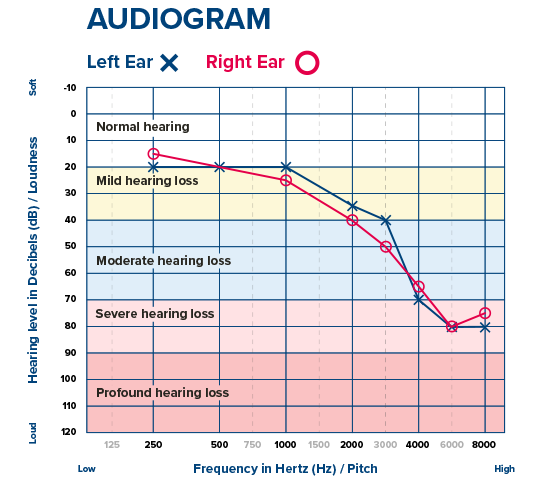
An audiogram is a graph or chart that displays the results of your comprehensive hearing evaluation.

The X-axis shows the different pitches of the sounds that were played to you during your test. This axis is laid out like piano keys, where low-pitched sounds are on the left and higher pitches are towards the right of the graph.

The Y-axis shows the loudness which increases as you go down the graph. The points on the graph demonstrate how loud the sounds needed to be in order for you to hear at each pitch test.

Circles (red) symbolise your right ear and crosses (blue) symbolise your left ear.

Book a free hearing test to receive your own audiogram results.

Audiogram chart showing hearing levels for left ear (blue X) and right ear (red O) across frequencies, with ranges for normal hearing, mild, moderate, severe, and profound hearing loss.
Audiologist consulting with a patient in a clinic setting

Seek early treatment for hearing loss

Gradual hearing loss is fairly common in the ageing process. But this doesn't mean that it should be ignored!

Since even mild hearing loss is associated with cognitive decline and other consequences of untreated hearing loss, all hearing loss should be treated with hearing aids or other treatment options.


Find a hearing clinic Hearing loss treatment

Treating all degrees of hearing loss

If you think you have hearing loss but you've been putting off getting a hearing aid, you're not alone.

Only 1 in 4 people who could benefit from hearing aids actually use them

While taking the first step can be the hardest part, seeking treatment as soon as possible is in your best interest. The Scripps Research Institute has found that hearing loss, when left undiagnosed or untreated, has the potential to worsen over time. Being proactive in seeking treatment in the early stages of hearing loss is therefore beneficial for both your current and long-term hearing health.

Hearing aid finder

5 steps to improving your hearing

Senior woman with gray braided hair touching her ear while looking into a mirror.
1. Hearing loss or maybe it's just earwax?
Book earwax removal
Senior woman wearing a modern hearing aid while using a tablet
2. Schedule your FREE hearing test in a clinic near you.
Find your clinic
Senior woman holding a hearing aid
3. Select a pair of hearing aids with a 90-day money back guarantee.
Book a hearing test
elderly person in a striped sweater speaking with a hearing care professional
4. Learn about 2 FREE hearing aids with PRSI grant.
PRSI grant
Elderly woman with long gray hair wearing a brown jacket and a hearing aid, seated outdoors with a green blurred background.
5. Hear well and live well. Receive FREE, unlimited aftercare.
Aftercare service

Invisible hearing solutions

Today’s hearing aids are more technologically advanced and more discreet than ever.
Some modern hearing aids are practically invisible, and yet they still offer excellent sound quality even in difficult listening situations.


Trial a hearing aidInvisible hearing aids

audiologist female
Written by: Sarah Sheehan, Chief Audiologist, ISHAA Member
Sarah Sheehan is an esteemed member of our HR, L&D and Compliance Department, who joined Hidden Hearing in 2018 as an audiologist. Sarah’s career has seen her work in a wide range of areas within the company and she is committed to providing education about audiology and keeping abreast of current audiology trends.

Last reviewed 2025-07-01

FAQ about hearing loss levels