






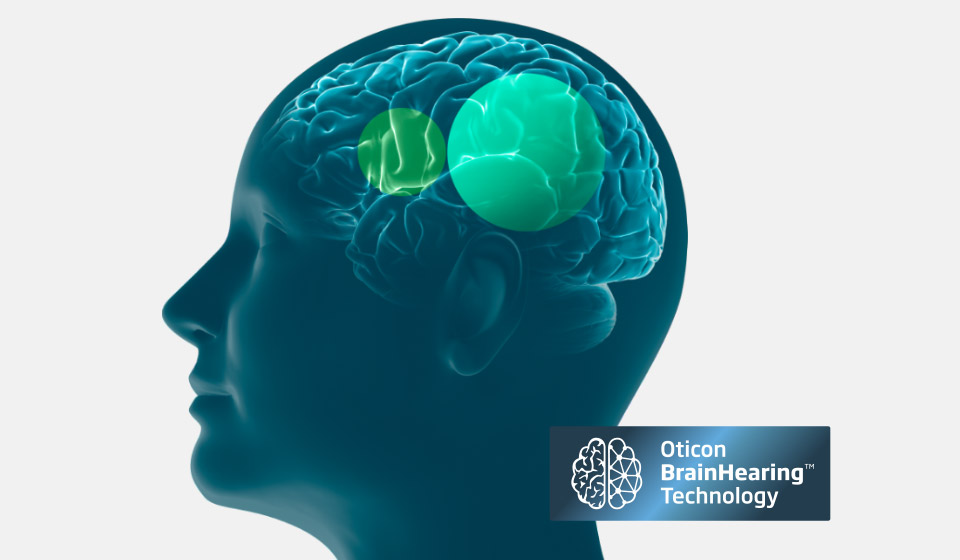
What is BrainHearing™?
BrainHearing™ is a technology developed by the hearing aid brand Oticon*. The technology helps hearing aid users get access to the full sound scene.


4 benefits of BrainHearing™



Try hearing aids with BrainHearing™
Why is BrainHearing™ relevant to you?
While your ears collect the sounds around you, your brain is responsible for processing these sounds. If you have normal hearing, you are able to hear all the different sounds around you. When you have hearing loss, your brain receives less information about these sounds. In this case, you may experience:
- Increased mental load
- Social isolation and depression
- Poor balance and fall-related injuries
- Dementia and Alzheimer's disease
Built on BrainHearing™ technology, Oticon hearing aids give your brain access to the full sound scene and support your brain in working more effectively.
Having access to the full soundscape ensures that your brain can hear better with less effort.
When you hear better, your brain stays active. This consistent brain activation is important for your health because it places your brain at a decreased risk for cognitive decline.
Would you like to try a pair of hearing aids with BrainHearing™ technology?

What makes Oticon BrainHearing™ different?
Did you know that you hear with your brain? Your ears collect sound, but it’s your brain that actually understands it.
Oticon's BrainHearing™ technology focuses on understanding how the brain makes sense of sound so that hearing aids with this technology can support your brain’s natural way of working.
How does Oticon BrainHearing™ technology work?
BrainHearing™ technology in hearing aids supports the brain’s natural way of processing sound. It gives the brain access to the full soundscape so that you can focus on the most relevant sounds and understand more with less effort.
- BrainHearing™ balances the overall soundscape so that you can focus on the most important sounds around you.
- BrainHearing™ allows you to hear speech more clearly as it enhances and clarifies speech sources near you.
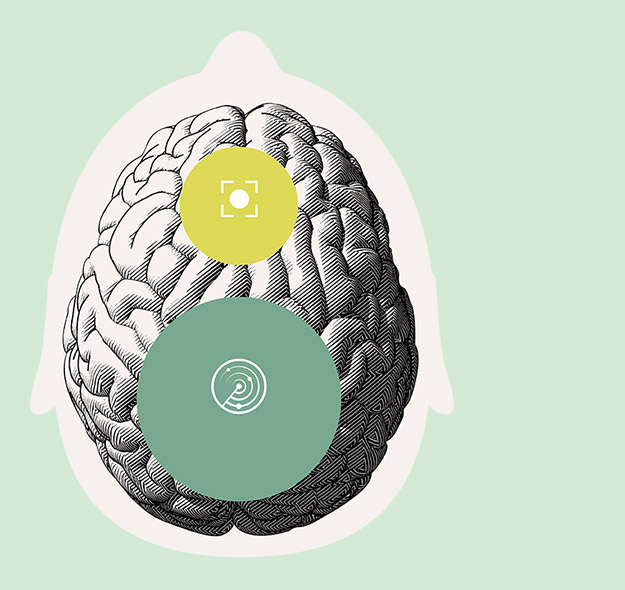
How does the brain make sense of sound?
The hearing centre in the brain is made up of two subsystems: the orient subsystem and the focus subsystem.
- The orient subsystem scans the surrounding area for sounds and creates an overview of the sounds around you.
- The focus subsystem selects which sounds to focus on, while filtering out irrelevant sounds.
These two systems constantly interact to make sure that the brain’s present focus is on the most important sounds. Hearing aids with BrainHearing™ support the way in which the brain naturally processes sound. It ensures that you hear as much as possible, with as little effort as possible.
Advice from an audiologist
When it comes to hearing loss, it's important to seek out a solution that will best serve your hearing needs - without compromise. Getting the highest level of care and seeking the best solution possible will likely have a positive impact on your overall quality of life.
Our team of audiologists recommends that you select a high-quality hearing aid if you have hearing loss. High-quality hearing aids give you the full sound perspective so that your brain can process sound as naturally as possible (rather than simply amplifying the sounds around you).
This high-quality treatment leads to enhanced brain stimulation and lowers your risk for long-term health problems, such as cognitive decline.



.png?rev=67e9b630deff4f4e80cbb4a45ab02d1b)
Sources
2. Hearing aids, information on hearing loss and tinnitus. (n.d.). Retrieved from https://www.oticon.global/hearing-aid-users/blog/2019/why-healthy-hearing-is-vital-in-fighting-dementia
3. Lin, F. R.. (2011, February 1). Hearing Loss and Incident Dementia. Archives of Neurology. https://jamanetwork.com/journals/jamaneurology/fullarticle/802291.
4. Lin, F. R., & Ferrucci, L. (2012). Hearing loss and falls among older adults in the United States. Archives of internal medicine, 172(4), 369–371. https://doi.org/10.1001/archinternmed.2011.728
5. Livingston G, Huntley J, Sommerlad A, Ames D, Ballard C, Banerjee S, et al. . Dementia prevention, intervention, and care: 2020 report of the Lancet Commission. Lancet. (2020). https://www.thelancet.com/journals/lancet/article/PIIS0140-6736(20)30367-6/fulltext
6. Oticon BrainHearing™. (n.d.). Retrieved from https://www.oticon.com/your-hearing/hearing-health/brainhearing-technology
7. Rönnberg J;Lunner T;Zekveld A;Sörqvist P;Danielsson H;Lyxell B;Dahlström O;Signoret C;Stenfelt S;Pichora-Fuller MK;Rudner M;. (n.d.). The Ease of Language Understanding (ELU) model: Theoretical, empirical, and clinical advances. Retrieved from https://pubmed.ncbi.nlm.nih.gov/23874273/